
The Minimalist Desk Setup That's Actually Good for Your Mental Health
How decluttered, nature-adjacent workspaces reduce cortisol, quiet the noise, and help you sustain deep focus all day long.
FlowSpace Living · Workspace Design
5/8/2024

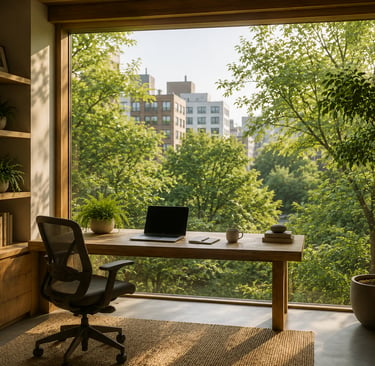
You sit down to work. The desk has three weeks of mail on the left, a tangle of cables on the right, an empty coffee mug in the middle, and a sticky note you wrote to yourself in February.
You open your laptop. You try to focus. But something keeps pulling at you.
It isn't distraction. It isn't laziness. It's your environment — and it's working against you.
Most home office advice focuses on what you put on your desk: the right monitor, the right keyboard, the right chair. But the research tells a different story. What you remove from your space has a more direct impact on your mental health and cognitive performance than almost anything you can add.
Here's what the science says — and what it means for the way you set up your desk.
Why clutter is a cortisol problem
Cortisol is your body's primary stress hormone. It's helpful in short bursts, it sharpens your focus in a crisis. But chronically elevated cortisol degrades memory, weakens executive function, and makes sustained, creative thinking nearly impossible.
Researchers at UCLA found that visual clutter in the home environment was directly correlated with elevated cortisol in the people who lived there, particularly during the afternoon and evening hours when the body is supposed to be winding down. The effect was measurable. The clutter wasn't just annoying. It was physiologically stressful.
34%
23 min
2x
lower cortisol reported in organized, low-clutter environments
average time lost to refocusing after a visual distraction
longer deep focus sessions in nature-adjacent workspaces
For tech professionals spending 6–10 hours a day at a home desk, this isn't abstract. Every object in your visual field that doesn't belong is a micro-stressor. Multiplied across a full workday, it adds up to a nervous system that never fully settles, and a brain that can never fully focus.
What "nature-adjacent" actually means for a desk setup
You don't need a forest view. The concept of biophilic design, the practice of connecting built environments to the natural world, is far more accessible than it sounds.
Research from the Human Spaces Global Report found that employees with access to natural light and greenery in their workspace reported 15% higher wellbeing and 6% higher productivity. A separate study from the University of Exeter found that even a single plant within view of a workstation meaningfully improved concentration and perceived air quality.
The goal isn't decoration. It's sensory calibration. Your nervous system evolved in natural environments. When the space around you echoes that — with organic textures, natural light, living plants, warm tones — your threat-detection response quiets down. Cortisol drops. Focus deepens.
"A clear mind starts with a clear space. But a calm mind starts with a space that feels like it belongs to the natural world."
The five principles of a desk setup that supports mental health
1. Visible surface, cleared to function
Your desk surface should contain only what you are actively using in this session. Everything else — mail, notebooks, devices, cables — belongs somewhere else. The research is consistent: visual surface area that is clear and purposeful reduces cognitive load before you even begin working. A clean desk isn't an aesthetic preference. It's a cognitive advantage.
2. One living plant within sightline
Place a single, low-maintenance plant where your gaze naturally rests, beside your monitor, on a shelf at eye level, or on the windowsill behind your screen. Snake plants, pothos, and peace lilies thrive in overcast winters and require almost no maintenance. One plant. One visible piece of the natural world. That's enough to shift your nervous system's baseline.
3. Maximize natural light — and position correctly
Sit perpendicular to your window, not facing it or with your back to it. Facing creates glare and visual fatigue. Back-to means your monitor is backlit, straining your eyes. Perpendicular gives you natural light as an ambient fill — your brain registers daylight, your circadian rhythm stays regulated, and your screen is easy to read. On grey days, a daylight-spectrum desk lamp (5000–6500K) fills the gap.
4. Zero visible cables
Cable clutter is one of the highest-density visual stressors in a home office — and one of the easiest to eliminate. Cable channels, a simple cable management tray under the desk, or even a single Velcro tie can remove an entire category of visual noise. You don't have to be minimal everywhere. But zero visible cables has an outsized return on cognitive calm.
5. A single, dedicated "tomorrow" tray
The items that linger on desks are almost never there because someone forgot about them. They're there because there's no designated home for them. One simple tray — not a pile, a tray — gives everything a landing spot. When your brain knows the system, it stops scanning the surface for what might be lost. That low-level vigilance is quieted. And sustained focus becomes possible.
Before and after: what the shift looks like
Most home desks
Cables pooling on the surface and floor
Papers and mail with no system
Multiple devices competing for attention
Artificial, cool-toned overhead light
No natural elements in view
Work bleeds into every hour
A FlowSpace setup
All cables routed and hidden
One tray, one inbox — everything has a home
One active device on the surface
Natural or daylight-spectrum lighting
One plant in the sightline
Clear off-switch: space signals when work ends
The space you work in shapes the person you work as
None of this requires a renovation. It doesn't require a big budget or a bigger apartment. It requires intention and a system.
At FlowSpace Living, we work with tech professionals to design exactly this: calm, high-functioning home workspaces that reduce stress, eliminate visual friction, and make deep focus feel effortless. We use what you already own, rearranged with purpose.
Every week you spend working in the wrong environment is a week of clarity you don't get back. Imagine a Monday morning where the desk is clear, the light is right, and your brain settles into work within minutes — not after an hour.
That's not a fantasy. That's a design problem. And it's one we can solve.
FLOWSPACE LIVING
Ready to build a space that works with your brain?
Book a free 30-minute call and we'll walk you through exactly what's creating friction in your home office and how to fix it, using what you already have.